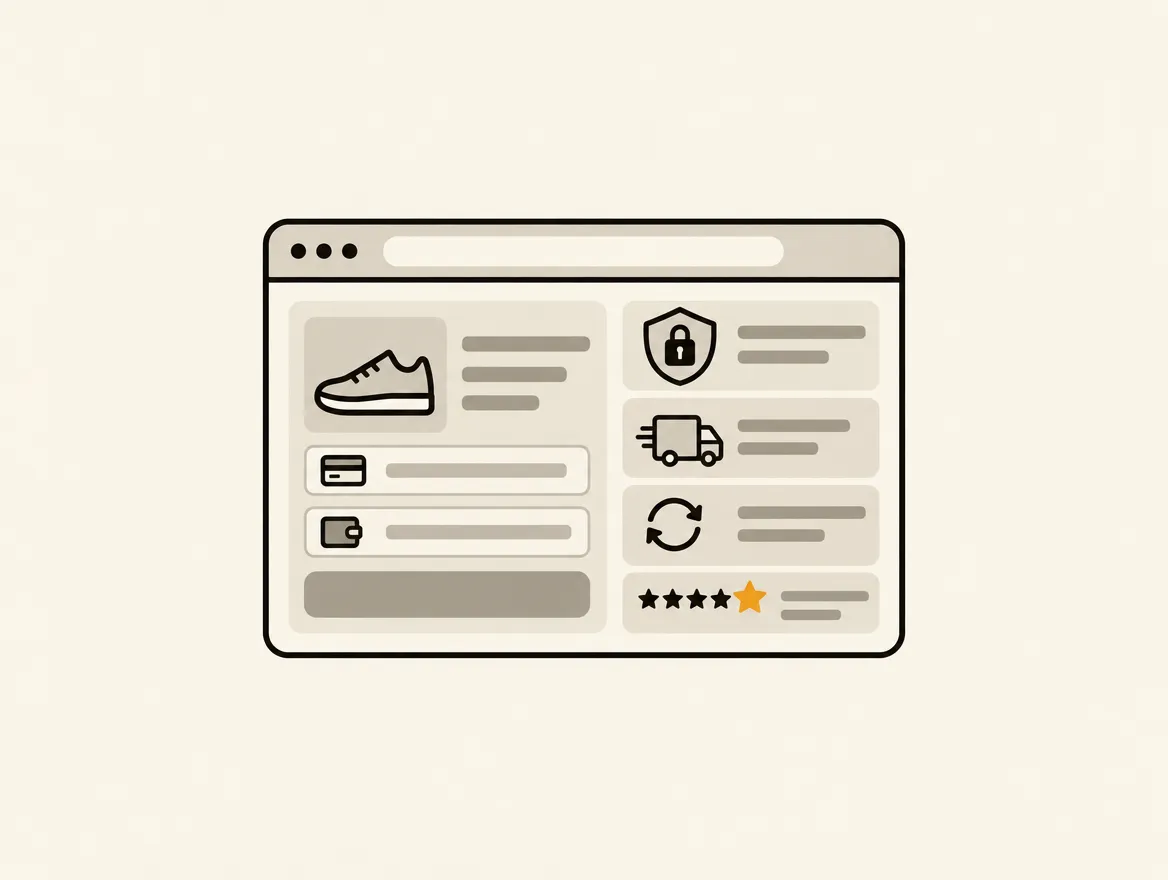
A shopper has added a product, accepted the price, and reached checkout. This is not the moment to make them hunt for delivery dates, question a charge, or wonder whether returns will be difficult. Checkout trust signals answer those questions before doubt becomes abandonment.
For Shopify teams, the work is less about adding a row of generic badge icons and more about removing uncertainty at the exact point it appears. The strongest signals are specific, consistent with the rest of the storefront, and visible before a buyer is asked to commit.
What buyers are judging at checkout
Buyers do not evaluate checkout trust as one abstract feeling. They make several fast decisions: Is the total accurate? Will this arrive when I need it? Can I use my preferred payment method? What happens if the item does not work out? Is this store legitimate enough to give card details to?
A checkout can be technically secure and still fail these tests. A small lock icon does not resolve an unexpected shipping fee. A well-known payment wallet does not compensate for a return policy that disappears once a shopper leaves the product page. Trust is cumulative, but the weakest unresolved question can still stop the order.
That is why generic reassurance often underperforms. “Secure checkout” is vague. “Free standard shipping, delivered Oct. 12-15” is operational. “30-day returns, with a prepaid label” is more useful than “easy returns.” Specificity lowers the buyer’s mental workload and gives your team something concrete to audit.
Checkout trust signals buyers need to see
Total cost and shipping clarity
Unexpected costs remain one of the fastest ways to lose an otherwise qualified shopper. Show shipping thresholds, delivery options, duties where relevant, and any handling charges as early as the checkout flow allows. If a promotion requires a minimum cart value or excludes certain products, make that rule legible before the final payment step.
The key is consistency. If a product page says “free shipping,” but the cart adds a regional surcharge, the issue is not only the surcharge. It is the contradiction. Audit product pages, cart messaging, shipping settings, and checkout output together. A message that is true for most orders but false for a meaningful segment is a conversion risk.
Delivery estimates need the same scrutiny. Avoid broad promises that your fulfillment operation cannot reliably meet. For some stores, a precise arrival window is possible. For others, a clear processing time plus carrier service level is more honest. The right choice depends on inventory locations, cutoff times, and whether items ship separately.
Recognizable payment options and secure handling
Buyers look for payment methods they already use, especially on mobile. Accelerated wallets can reduce form friction and lend familiarity because the customer recognizes the payment environment. But payment options are not a substitute for clear pricing and fulfillment information.
Security language should be restrained and accurate. Your checkout platform already provides protections, so do not create homemade claims that imply guarantees you cannot support. The useful signal is a professional, uninterrupted path to payment: no mixed visual styles, no broken logos, no unexpected redirects, and no fields that look unfinished.
Test this on actual devices. A payment option can be configured correctly yet be hidden behind a poorly placed element, unavailable for certain carts, or confusing when an express checkout changes the sequence of shipping and contact information.
Returns, support, and policy access
A shopper who reaches checkout may be one unanswered question away from purchasing. Give them a compact route to support and the policies most likely to affect the decision: returns, exchanges, shipping, and privacy. The goal is not to force customers through a legal document at checkout. It is to make the answer available without losing their cart.
Policy language also needs to match the products. Final-sale items, made-to-order goods, subscriptions, and international shipments may have different terms. If an exception exists, surface it near the relevant product or cart line, not only inside a general policy page.
Support availability is a trade-off. Live chat can reassure customers when it is staffed and responsive. When it is not, a visible chat launcher that leads to a delayed response can create more doubt. A clear email response-time expectation or concise help route is better than an inactive promise.
Error prevention and form confidence
Trust drops when checkout appears to reject the customer without explanation. Inline validation should identify the field, explain the issue, and preserve entered data. Address suggestions, phone number formatting, and promo-code feedback should help the buyer proceed rather than make them retry blindly.
Mobile deserves special attention. Tiny tap targets, keyboard-obscured fields, poor contrast, and vague error messages are usability defects with a trust cost. The customer may assume the payment failed, the order was submitted twice, or the store is not reliable enough to troubleshoot.
After payment, confirmation is another trust checkpoint. The order confirmation should state what was purchased, what was charged, where it will ship, and what happens next. For orders with long lead times or split fulfillment, the confirmation must set that expectation immediately.
Placement matters as much as the signal
A trust message shown after the shopper has entered card details is often too late. Put shipping thresholds and return expectations on product and cart pages, then reinforce the relevant details in checkout. This repetition is not clutter when each placement answers a decision appropriate to that stage.
Do not crowd the checkout with every credential, review, guarantee, and policy excerpt. Excessive badges can look defensive, especially if they compete with the order total and payment action. Prioritize the signals tied to the highest-risk questions in your store.
For a high-AOV product, delivery protection, financing details, warranty coverage, and accessible support may carry more weight. For a replenishable, low-cost item, shipping cost, subscription terms, and fast payment options may matter more. Review the cart mix, customer-service tickets, refund reasons, and abandonment data before deciding what to display.
How to prioritize checkout trust signals
Treat trust defects as a prioritized operational queue, not a design preference debate. Start with issues that affect all buyers or create a direct contradiction: hidden shipping costs, missing delivery information, unusable payment methods, inaccessible policy links, and checkout errors.
Next, look for segment-specific failures. International shoppers may not see duty expectations. Mobile buyers may have a broken wallet button. Customers with discount codes may receive unclear feedback. These problems can be easy to miss in a desktop-only review, yet they affect revenue from valuable traffic segments.
Each finding needs evidence. Capture the exact URL or checkout state, device or viewport, affected product or shipping region, screenshot, expected behavior, and observed behavior. Then assign an impact and effort rating. “Improve checkout trust” cannot be owned. “Show estimated delivery range for in-stock US orders in cart and checkout” can.
This is where a persistent workflow is more useful than a one-time audit. Horavo can turn visual evidence and storefront findings into assigned tasks that remain open until the condition is verified, rather than letting a screenshot disappear into a PDF or spreadsheet.
Verify the fix after deployment
Do not mark a trust issue complete because a component was added in a staging design. Re-test the live store with representative carts: discounted and full-price orders, physical and digital items, different shipping destinations, mobile and desktop, and the payment methods your customers actually use.
Then watch what changes. A lower checkout abandonment rate is useful, but it is not the only signal. Track payment failures, support contacts about shipping or returns, coupon errors, refund requests tied to expectations, and completion rates by device. Conversion movement can be affected by traffic quality and promotions, so pair analytics with direct evidence from the flow.
The most valuable checkout trust signal is the one that answers a real buyer question before they have to ask it. Find those questions in your data, make the answers visible, and keep checking that the storefront still delivers on them.